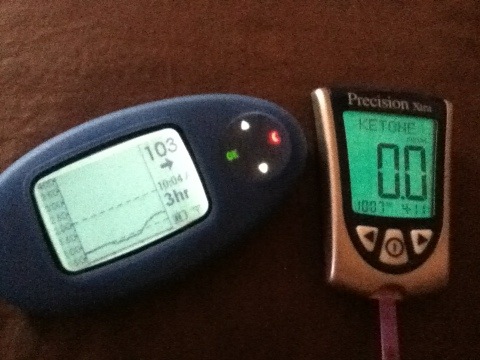
At times like now when I am sick, I am so very grateful for these devices.
At times like now when I am sick, I am so very grateful for these devices.
I’ve posted before about the lack of glucose meter accuracy and if we’re friends on Facebook, you’ve seen pictures I’ve taken comparing meter results. When I was using the One Touch Ping meter that worked with my pump, I had issues with it giving me false low readings. Luckily I have the Dexcom CGM so in seeing the discrepancy between meter and sensor readings, I would retest to get a higher reading. One Touch was very accommodating and sent me a new meter which solved that issue. Mostly. At the time my CDE suggested I try the Freestyle meter which I did and switched for some time to primarily use the Freestyle Lite. I did many comparisons between the two meters with the same blood sample and got substantial differences. I put a stop to that pretty much for my own sanity. In the end I stuck with the Ping meter mainly for convenience of the remote bolus function with my pump and also being a long time One Touch user.
Then, two months ago, I switched to the OmniPod system and the Freestyle PDM became my primary meter since it also functions as the manager to all insulin dosage functions. In that same time period, I purchased the new One Touch Verio IQ meter. Although the Verio is not my primary meter, I do like it a lot. Of course I have done some reading comparisons between the two. And I’m back to getting very considerable differences.

A couple of weeks ago I read a post by Mike over at Every Day Ups and Downs. He had reviewed the new iBGStar meter from Sanofi. In his review, he noted that the iBGStar was giving him readings higher than other meters (Accu-chek Expert and Contour Link). In posting his results, he got confirmation from Sanofi that “the iBGStar has been developed to give readings which are automatically corrected against Haematocrit* and plasma values. Both of these corrections can mean that your new iBGStar monitor may give readings higher than you are used to. If you have any concerns over what this change of readings may mean, we would advise you to consult your doctor or other healthcare practitioner for further training.” This made me wonder if the new Verio has been developed similarly.
Also, a few days ago I read a post by Adam over at diaTribe, reviewing the new meters on the market, including the Verio. In his findings, the Verio had 100% accuracy with results under 75 mg/dL and 95% accuracy with results over 75 mg/dL compared to lab readings. That is some pretty solid findings. It also made me wonder about my own comparisons using the Verio.
While I appreciate all the new technology coming out or being worked on – mySentry, Telcare, AP, etc. and think they are hugely beneficial to the lives of those living with diabetes, what I want the most is a BG meter that will give me results I can rely on. One that will not be just plus or minus 20% of my actual BG. My next endo appointment is in 3 weeks and I plan on taking both the PDM and Verio meters to be tested at the lab. If the Verio results are indeed more “accurate”, as much as I wouldn’t want to, I would consider changing it to my primary meter. It will be an inconvenience in some ways but may be worth it if it means trusting the results more.
FDA and BG meter companies – without accurate BG readings, all else in our management means nothing. I can eat all the right things, count every last carb, test 20 times a day, exercise every single day and dose the most precise amount of insulin. But if my readings aren’t accurate all of those other things will not help me keep my diabetes in control. I can’t help but wonder if this is the very reason I cannot seem to get my a1c under 7. My BG levels may not actually be what they seem. And that to me, as a person with diabetes, is a huge problem.
When I was at the JDRF Research Summit last month, the main focus of the presenters was the progress, current efforts and complexity of finding a cure for type 1 diabetes. There was also mention by Dr. Desmond Schatz (Professor and Associate Chairman of Pediatrics, Medical Director of the Diabetes Center and Director of the GCRC at the University of Florida, Gainesville) of the need for people in the diabetes community to get involved in research studies. And this makes sense. If doctors and researchers cannot identify the cause and possible factors that cause diabetes, they will not be able to cure it. I hate to admit that in my 30 years of living with type 1 diabetes, I have not participated in any research. But I changed that recently.
TrialNet had representatives at the summit and I approached them to see if there were any research opportunities for twins and type 1 diabetes. If you’ve never heard of TrialNet, “Type 1 Diabetes TrialNet is an international network of researchers who are exploring ways to prevent, delay and reverse the progression of type 1 diabetes. TrialNet was established in response to the Surgeon General’s Report Healthy People 2000. This report identified diabetes as a national health objective for the Nation. In response to the report, Congress created the Diabetes Research Working Group (DRWG) to develop a plan for diabetes research. One recommendation of the DRWG was to conduct additional research studies (clinical trials) to prevent type 1 diabetes.” “TrialNet is conducting clinical trials with researchers from 18 Clinical Centers in the United States, Canada, Finland, United Kingdom, Italy, Germany, Australia and New Zealand. In addition, more than 150 medical centers and physician offices are participating in the TrialNet network. Studies are available for people newly diagnosed with type 1 diabetes, as well as for relatives of people with type 1 diabetes who are at greater risk of developing the disease.” So of course they organize a study for type 1 diabetes and twins. If you don’t know already, I have an identical twin sister who does not have diabetes. And if you think about us developing from the same egg, having nearly identical DNA, having the same environmental influences both in my mother’s womb and growing up, not to mention having the same father who had type 1 as well, it makes me wonder why my beta cells destroyed themselves but not my sister’s. (Not that I am in ANY way wishing she had it too. This is strictly a scientific marvel) Both my sister and I gave blood samples that were mailed to TrialNet for the to test for certain antibodies related to type 1 diabetes. I was very happy to take part in research that will help the mission of finding a cure for diabetes. Even if I don’t see the cure in my lifetime, it would please me to know that I helped people after my time.
Research is very critical to finding a cure for diabetes. And who better to help with that research than those of us already living with the condition? Please check out TrialNet’s website (https://www.diabetestrialnet.org/index.htm) and see what clinical trials you would be able to participate in. It will benefit the entire diabetes community!

image credit: JDRF
I live with a type of diabetes that cannot be prevented or reversed. My diet or weight as a five year old had nothing at all to do with why I was diagnosed. I have taken insulin every day for the past 30 years to stay alive. Eating right and exercising of course helps me stay healthy overall and does improve my blood sugar readings but it will not get rid of my diabetes. There are about 900,000+ other people in the US alone who are in the same boat as me. But that is only 5% of the diabetic population. There are approximately 18 million more people in the US who have type 2 diabetes. Type 2 diabetes is when the body does not produce enough insulin or does not utilize it properly. It is sometimes linked to diet and(or) lifestyle. There are different treatment options for type 2 diabetes depending on each case, including diet and exercise, oral medication and insulin.
The CDC estimates that there are an additional 7 million people in the US that have diabetes and do not know it. That is an astounding number. Any type of diabetes is no joke. But you can live a fulfilling life with diabetes as long as you get the medical care you need. Today is American Diabetes Association Alert Day. If you aren’t already living with diabetes, please take a few minutes to take the ADA’s risk test for type 2. And share it with your friends and family members. Early diagnosis is crucial. I was extremely fortunate to have parents who recognized the symptoms before I was even sick. And I am certain that has helped me maintain a life of diabetes with minimal complications up to this point. Knowledge is power when it comes to anyone’s health. And if you or someone you love happens to be diagnosed with diabetes, know that there is an extraordinary community waiting to help you.

I haven’t been feeling well for going on two weeks. Not exactly sick but not well. When you have diabetes, any little ailment or ill feeling causes more questions and concerns than normal. And I hate that. Things like the sniffles or a little dizziness or some fatigue can be brushed off by a person without diabetes if they choose. But when you have to worry about your BG as well as the feeling you are experiencing, it’s a whole different ball game. Your mind begins to wander about the cause of your suffering. Could I be starting with another auto immune condition? Could it be complications? Is it diabetes related at all? To determine if your high BG is being caused by not feeling well or if not feeling well is being caused by your high BG is next to impossible. Not to mention making sure ketones aren’t part of the scenario. It can all be a bit overwhelming.
As for what has been ailing me, I’m hoping to find out. I’ve already had a couple of things ruled out and have a few appointments scheduled in the coming week. I have a feeling most of my symptoms could very well be allergy related believe it or not. And if that’s all it is, I can deal with that. I really just want to feel back to normal already. Especially to get back to working out. (did I really just write that??) But I take not feeling well very seriously. Maybe too seriously? And I can’t help but place the blame for that on diabetes.

Not terrible but still crappy and unusual for me. Since I haven’t been feeling well, this just proves that something is going on!
Low blood sugars don’t normally scare me. Sure I’ve had times where I have felt unwell enough to be a little concerned but generally speaking I don’t have a great fear of them. I don’t feel the urge to eat everything in sight to treat a low. I stick to my juicy juice box or maybe a soda or glucose tabs if I have nothing else available and I’m usually good in a reasonable amount of time. It could be because I’ve (thankfully) never lost consciousness, I’m not sure. I’ve also never lived alone. I went from living with my parents and sister to living with my hubby.
Two weeks ago however, I had an incident that had me in tears from fear. I was working from home so was alone in our apartment. It was not quite 2 hours post breakfast that the reading on my Dexcom caused me some concern.

I checked with my meter and confirmed I was actually dropping that much with a 76 mg/dL. I grabbed a juice box and also decreased my basal by about 50%. The double arrows on the Dexcom went away but I was still dropping. About 35 minutes, this is what I saw.

I started to get nervous at this point. Less basal, juice and I was still dropping. And feeling completely fine. That is what scared me the most I think. I have not been feeling my lows at all lately and I was afraid that since I wasn’t feeling low that all of a sudden I was going to be low enough to not be able to help myself. So I suspended my insulin and had another juice box. Another 15 minutes later I was still dropping.
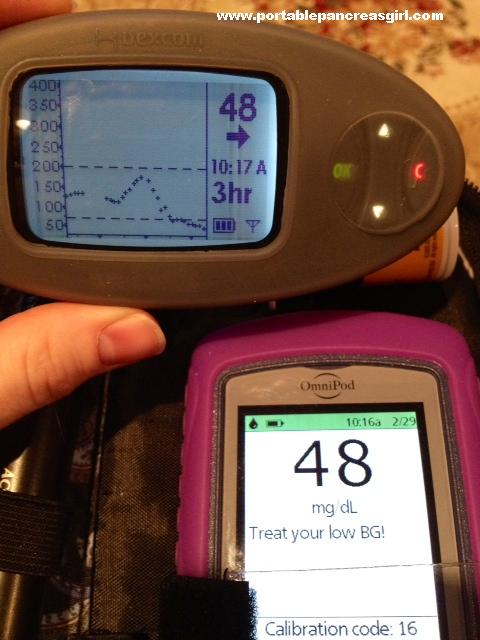
I don’t know if it was the fear or the actual low but I started not to feel well. And so I got even more panicked. I decided to get the glucagon out and gave myself a shot in the leg. I didn’t know if I was overreacting but at the moment, by myself, it seemed like the right thing to do. I also thought I was going to regret it with BG in the 300’s but guess what? About 2 hours later, finally, I peaked at 165.

I was never so scared. I was never so relieved. I was never so thankful to have the right tools to help me monitor this blood sugar. I can only imagine what could have happened in this situation when I was first diagnosed 30 years ago without even a glucose meter to test with. Most days diabetes isn’t that scary. But some days it can be very scary.

I have made two rather major changes to my diabetes management recently. And I can’t say for sure if it’s one or the other, or a combination of both, but I have seen improvements in my overall BG readings. Which of course is a good thing. For the first time in my insulin pumping life (5+ years) my CDE reduced ALL of my basal rates. Each and every eight of them. That has never happened since I’m on the pump. I wasn’t sure how I felt when I left her visit. I wasn’t exactly experiencing way too many lows. But there have been hours at a time in the past couple of weeks where I’m stuck around the 70-80 mg/dL range. And the lows I have had, she was able to trace to too much basal insulin. So I thought the worst that can happen is I run high and change them back. Right?
Well my first day on my new basal rates have resulted in readings of 60, 99, 112, 152, 142, 115, 106 and 122 mg/dL so far, with the Dexcom line to go with it. I am pretty surprised actually. I guess the reductions may not be too much like I thought! Props to M 😉
So what are these changes you are probably wondering? Switching from Novolog to Apidra insulin and from a tubed pump to the OmniPod. Now your guess is as good as mine why the OmniPod would better control my BG. My guess would be that there is no tube for the insulin to go through so a more direct delivery into my system? No kinks or bubbles from tubing? An angled infusion set as opposed to a straight one? Has any of this been proven? Not that I know of. But for some reason it seems to be working better for me. The Apidra has improved my postprandial (post meal) numbers. My current endo, as well as my previous one, felt there wasn’t much difference between Novolog, Humalog and Apidra. But according to their website “Apidra® works quickly to help control mealtime blood sugar ‘spikes’. You can take Apidra® rapid-acting insulin within 15 minutes before your meal, or within 20 minutes after starting a meal.” I had tried Apidra once about a year ago or so and didn’t stick with it for some reason. But this time I paid more attention and tracked the difference it has made.
Whatever the scientific reasons behind these changes improving my BG results, I truly hope it continues. I’d really love to see an improvement in my A1c in April.
*please keep in mind that I am in no way stating that taking Apidra or using the OmniPod will improve everyone’s diabetes management – don’t forget – your diabetes may will vary*
So I’m a bit late on this one … this has been out for quite a while but I got my very own Tummietote from Tallygear in the mail yesterday. And I used it during my workout last night.

But let me take a few steps back. Living with diabetes in this day and age, there are a few devices that you need to have with you all the time. Some of these may even have to be on you. With that in mind, short of creating a “tool belt” for diabetics, Donna and Matthew created the Tallygear line for their daughter Tally who was diagnosed with type 1 diabetes in 2007. From their site “Our wish for you or your child is to make wearing an insulin pump or any other personal item more comfortable and secure. We began with the idea to create a belt to make wearing the insulin pump more comfortable…we believe we have gone beyond that. The belt is not only comfortable but, it is also extremely stylish and can be very discreet.”
I’ve heard so many great things about this product but never got around to getting myself one. After recommending it to a twitter friend based on others’ reviews, I decided to order one. And I’m really glad I did. Recently switching to the OmniPod, I no longer have an external pump to wear somewhere on my body. But I do see how convenient this belt would be for a pump. I do however, still need to carry my Dexcom receiver with me all the time. That fits perfectly in one of the pockets that closes with velcro and is easily accessible to view my BG trends. It has three of those pockets altogether. The belt is extremely comfortable; it is wrapped around your tummy with velcro. I also like how soft the material is.


They come in so many different fun colors and patterns and various styles too. I would also recommend this belt for people who do not have diabetes. You can very well fit an iPod, phone, or other little important little gadgets in it to take with you on the go, especially when active.
*Tallygear did not provide me with their product for review. I purchased the Tummietote on my own accord and these opinions are strictly my own.*
This past weekend I had the great opportunity to attend the JDRF Type 1 Research Summit in Maryland hosted by the JDRF Capitol chapter. I have attended diabetes events before but never one that was focused on research for advancements in management and a cure for type 1 diabetes. I’m really glad I went.
Joe and I made a weekend trip out of it and did a little sight-seeing in DC. That was nice.

Of course the first thing I spotted when getting out of the metro station was Crumbs bakery! We didn’t indulge but just seeing the sign put a smile of my face 🙂

We also got a glimpse of the Occupy DC movement that still resides near the capitol.

The summit itself was a day full of education to say the least. We heard from presenters like Dr. Juan Dominguez-Bendala from the Diabetes Research Institute, Adam Brown from Close Concerns and diaTribe, Dr. Mark Atkinson and Dr. Desmond Schatz from the Diabetes Center of Excellence at the University of Florida, Dr. Stuart Weinzimer from Yale School of Medicine Pediatric Endocrinology, Cynthia Rice from JDRF Government Relations, Marie Schiller from Health Advances and T1D First and Gary Scheiner from Integrated Diabetes Services. The moderator was Riva Greenberg, columnist at the Huffington Post. I thought each and every one of the presentations were very informative and well demonstrated.
A lot of the guests spoke about the current and future research that is being done for type 1 diabetes. Some in terms of the steps to get to the artificial pancreas and some in terms of getting to a cure. I won’t pretend that I understood all the scientific or medical terminology but it did reiterate how extremely difficult it is to find a cure that will work. I’ve been living with diabetes for 30 years already and for so many of those first years, my family and I heard that there would be a cure in the next 10 years or so. For this reason and not being a pessimist, I don’t think I will see a cure in my lifetime. However, hearing all that is being done in terms of research, even to improve the quality of diabetes management, does give me a little more hope to hang on to. Especially after hearing Gary’s presentation about how much things have changed in the last 25 years. Who remembers the autolet lancing device (shown below)?? That thing was horrible!

One highlight of attending the summit was not only did I get to spend time with some of my D friends, I got to meet some more in person! I got to meet Tony, Colleen, Bennet and Kim and that was a huge plus to the weekend.

Another highlight was getting to see the t-slim insulin pump by Tandem in person at the exhibit hall. I got to hold it and test it out (without being hooked up of course). My initial opinion is that it is very sleek and slim – hence the name! It holds 300 units of insulin which is a plus to a lot of people. The touch screen makes moving around the menu and entering functions very simple and easy. Tandem says the pump is waterproof for up to 3 feet for 30 minutes. To me that’s not really water”proof” but better than nothing if getting caught in a downpour or accidentally coming in contact with a lot of water. The only thing that makes me hesitant about the device is that it has to be charged like other electronic devices. Charging something that is attached to you poses some doubts for me personally.

Overall it was a great experience and I applaud the JDRF Capital chapter for organizing a great event at no charge to the attendees. I would highly recommend going to any future conference to anyone that has a loved one with type 1 diabetes in their life.
 The Girl with the Portable Pancreas