Category Archives: Community

(Not So) Wordless Wednesday.

I am an adult.  Yet like stated in my blog bio “I love cute furry animals (of both the live and the stuffed variety!)”  Evidence of this is my own Build-a-Bear collection pictured below.

Since I already had my own stuffed animal bunch, when I heard about Medtronic’s Lenny the Lion, and especially that he was available for purchase, of course I had to get myself one!  He is the softest, most cuddly lion around 🙂

I think it’s great what he stands for and wish when I was a little child with diabetes, something like Lenny was around.  But since it wasn’t, I’ll just have to enjoy him as an adult 😉

My Diabetes Hero.

I’m a day late and two posts behind (sorry Karen!) since I was at the Diabetes Sisters Weekend for Women conference in Raleigh this weekend but this is a great topic and I also didn’t want to miss the grand finale of Diabetes Blog Week.  Day 7’s topic is this: “Let’s end our week on a high note and blog about our “Diabetes Hero”. It can be anyone you’d like to recognize or admire, someone you know personally or not, someone with diabetes or maybe a Type 3. It might be a fabulous endo or CDE. It could be a d-celebrity or role-model. It could be another DOC member. It’s up to you – who is your Diabetes Hero??”

There are many, many people in the diabetes community that I admire and look up to.  The parents of children with diabetes.  The athletes.  The mothers with diabetes.  So many others wo do not fall into these categories but are awesome just the same.  However, my diabetes hero is, and always will be, my father.

Plain and simple a good part of his life sucked because of diabetes.  He had gastroparesis that interfered with his digestion.  He had retinopathy that took most of his vision.  He had heart disease which caused him to have multiple heart attacks and congestive heart failure.  He had neuropathy that lead to the amputation of one his legs.  He had kidney disease that lead him to a short period of dialysis.  All of these things ultimately lead to him losing his life from diabetes.  But not without a fight. 

Sure he struggled with a great deal of depression and negative viewpoint.  He also blamed himself for my diagnosis.  I couldn’t begin to imagine how guilt like that feels.  But he didn’t want me to have the same attitude.  I have no doubt that my diabetes life would not be the same if it weren’t for him.  Maybe even unknowingly, he paved the way for me to stay positive.   

It may have taken me a while, but I live with diabetes better because of him.  I take care of myself knowing what could happen but doesn’t have to happen.  The empty spot in my heart that has been there since he passed away is also full of admiration for him.  For the way he fought against all those complications he endured.  He will always be a hero in my eyes.

Fantasy Diabetes Device.

Today is day 4 of Diabetes Blog Week and the topic is: “Today let’s tackle an idea inspired by Bennet of Your Diabetes May Vary. Tell us what your Fantasy Diabetes Device would be? Think of your dream blood glucose checker, delivery system for insulin or other meds, magic carb counter, etc. etc. etc. The sky is the limit – what would you love to see?

I know this topic is probably meant to get everyone’s thinking cap on and get creative.  And honestly I can’t wait to see what everyone came up with.  However, I am going to be boring and to the point 🙂 

There is one major thing that I would love to have in my diabetes devices which is sadly lacking in 2012.  Glucose.  Meter.  Accuracy.  Period.  You may even be tired of “hearing” me on this subject.  Yet I think it is something that we should all want and work hard to advocate for.  By definition, a fantasy is the faculty or activity of imagining things that are impossible or improbable.  Is greater meter accuracy impossible?  I wouldn’t think so although I’m no clincial expert.  Is more accruacy improbable?  At this point in time I’d say yes.  Sure the glucose meters available to patients today are faster, smaller and more accurate than they were when they first came out decades ago.  However, the current accuracy standard set by the FDA is + or – 20%.  This is not good enough.  Diabetes affects millions of people.  And the numbers continue to grow.  Diabetes is also managed by the patients close to 100% of the time, unlike many other conditions.  This means that those glucose meters used by people with diabetes every single day are the most important tool for them in staying healthy.  In preventing those dreadful complications.  In avoiding life threatening low blood sugars.  It is stressed by every medical professional in the world that tight control should be the goal of everyone living with diabetes.  Well how can that be achieved if the meters we use to monitor our BG readings aren’t accurate enough? 

So forget fancy insulin pumps or continuous gluose monitors.  Yeah those would be nice to have.  But as long as my pancreas isn’t working and I need to monitor my blood glucose in order to stay alive, I wish for gluocose meters that give me readings I don’t have to second guess.

One Thing to Improve.

Day 3 of Diabetes Blog Week’s topic is this: “Yesterday we gave ourselves and our loved ones a big pat on the back for one thing we are great at. Today let’s look at the flip-side. We probably all have one thing we could try to do better. Why not make today the day we start working on it. No judgments, no scolding, just sharing one small thing we can improve so the DOC can cheer us on!”

Yesterday I started my post with the notion that I do everything related to diabetes spectacularly.  Then I went on to say let’s get serious.  Which seems like the perfect intro to today’s topic! 

The main thing I would like to improve in regard to my diabetes management is my A1c.  My A1c’s growing up were always high by today’s standards.  (I’ll chalk that up to a few reasons why but not what I want to get into now)  Then some years ago, when my effort to manage my blood sugars was enhanced if you will, there was an improvement in my A1c levels.  But not as much as I would have liked.  Don’t get me wrong.  It’s not terrible.  And I’m glad that it has at least been stable for the past 2+ years.  But I cannot seem to get under that 7% mark.  And it’s tremendously frustrating.

With that being said, there are numerous things I can probably improve upon to possibly get that A1c improvement.  But for today’s topic I need to pick one.  Hmm.  This is actually a tough one.  I’d have to say logging is my biggest diabetes “failure”.  The only time I log anything is to write down what I eat and activities for a few days prior to my CDE appointements.  That’s about four times a year.  I never download my Dexcom data.  My CDE does this at my appointments with her.  The only time I download my meter readings is to print them out for my endo appointment.  On a day to day basis, I monitor my BG regularly and meticulously.  However on a big picture basis, I suck bigtime.  Granted I’ll notice if I’m say running high at nighttime and adjust my basal accordingly but only if it’s enough to stick out.  Like recently.  There are most likely other patterns to be spotted if I actually took a look more often at the bigger picture. 

Now that I’ve made a public confession of something I need to improve, I feel like the worst diabetes patient ever.  I better get working on that……………

One Great Thing.

Today’s Topic is this: “Living with diabetes (or caring for someone who lives with it) sure does take a lot of work, and it’s easy to be hard on ourselves if we aren’t “perfect”. But today it’s time to give ourselves some much deserved credit. Tell us about just one diabetes thing you (or your loved one) does spectacularly! Fasting blood sugar checks, oral meds sorted and ready, something always on hand to treat a low, or anything that you do for diabetes. Nothing is too big or too small to celebrate doing well!

So we have to pick just one great thing we do.  Well, it is really hard for me to pick only one great thing that I do spectacularly.  I do everything related to diabetes spectacularly!  I am thee perfect diabetes patient! 

Okay, let’s get serious.  If only the above were true, I’d be walking around with an A1c of 6% all the time and my Dexcom graphs would be flat lines constantly.  A girl can dream 😉 

With that being said, I do have to give myself credit for knowing what my blood sugar is.  I went from a period where I probably only checked about once a day, to testing (on average) a minimum of 8 times daily.  It may help just a little that I tend to have my hands on the latest, cool, glucose meter.  Hey whatever helps right?  But not only that, it has been over 2 years since I let a day go by without using my Dexcom.  And I act on those readings too.  If I’m high, I correct until I’m in a better range.  If I’m dropping, I try to head off a low by lowering basal insulin or having a small snack.  Knowing what your BG is, is a crucial piece of managing one’s diabetes.  I certainly don’t have anything perfected, even after 30+ years but I do try.  And I try hard.

I like this topic a lot.  Living with diabetes can seem so daunting and difficult and scary most of the time.  And there are so many moments potentially leading us to feel like we don’t do things well enough.  But we do many things well and focusing on the positive is something we should all do more often.  Thanks for this Karen!

Find a Friend.

Thank you so much Karen for coordinating yet another Diabetes Blog Week!  This year’s is starting off with this topic: “It seems the most popular thing about Diabetes Blog Week is that it helps us find blogs we weren’t reading yet and connect with some new blog friends. With that in mind, let’s kick off Diabetes Blog Week by making some new connections. Think about the d-blogs you read that you think we may not know about and introduce us to one that you love!! Let’s all find a new friend today!

I’ll admit that I’m not in the best frame of mind tonight and don’t want to seem like I’m taking the easy way out on this one but I’d like to point you all to my blog roll (on the lower right hand side of my page).  I’d love to introduce separate individuals that stick out in my mind but I honestly like to keep up with all those on my list (as best I can) and am glad to call them all friends.  Without all these people, there wouldn’t be a diabetes online community and everyone’s advocacy efforts should be commended!  Thank you friends, for all you do 🙂

A Heart to Heart with Ginger.

Ginger Vieira is one of those people from the diabetes community that I look up to and admire.  Not only has she been living well with diabetes, she made a career of helping people live well also.  I had the pleasure of meeting Ginger last year at the Unite for a Healthy Future event.  Her positive attitude, healthy outlook and smile are contagious.  I had some questions I’ve been wanting to ask her and she was nice enough to let me share it with all of you.       

S: Tell me more about your diabetes diagnosis.

G: The most unique part of my diabetes diagnosis is that I actually diagnosed myself and no one believed me for a week. I was 13 years old, in the 7th grade, and the entire 7th grade does a health fair every year. One of the kids in my class, Miles, did his project on “diabetes.” I had been feeling sick for about 3 weeks – my whole family got the flu, and it seemed like mine never went away! I started reading Miles’ poster on diabetes while we were in science class, and I had all of the symptoms listed. I told my mom later that day that I thought I had this “thing called diabetes.” We didn’t know anything about it, so she said, “No, no, that’s impossible.” A week later, I started crying because I felt so awful, and we finally went to the hospital.

S: Tell me more about your celiac diagnosis.

G: I’m really lucky in how quickly I was diagnosed with celiac. Most people don’t even get tested until they’re bodies are suffering and they feel really sick. By then, your small intestine has already experienced a great deal of damage. My endocrinologist just tested me on principle during the second year of my life with Type 1 diabetes.

I was very good at following my gluten-free guidelines throughout high school, and then I teetered out of those lines during college for about one year. In other words, I cheated whenever I felt like it! Because I was diagnosed so quickly, I really don’t have very noticeable symptoms, if any, to gluten. I would get a headache sometimes, but because I was eating small snacks of gluten so often, I stopped noticing how unhappy my body was.

Today, I can honestly say I have no interest in eating gluten (*cheating) because everything about my body feels healthier and happier when there is no gluten in my body. Can I get away with trying my best friend’s chocolate ganache cake pop sometimes? Yes…but I try to keep those “taste-testing” excursions to just 3 or 4 small bites a year.

S: How did you know you wanted to be a trainer/coach?

G: Well, it was really never something I thought about until I had hired a personal trainer for my own health goals during my senior year of college. Within a year of training with him, I knew I wanted to motivate people to take good care of themselves, to see how much they are capable of, to become stronger and more confident in their own skin than they thought possible!

I never thought of myself as an athlete until that year. During the next year, amidst powerlifting competitions and training, I realized I wanted to do more than just teach people how to exercise, I wanted to help them change the way they see the challenges in their health, change the way they pursue their goals, and change the way they literally think about themselves.

That year, I began training as a cognitive coach in David Rock’s coaching program that is based on the neuroscience of the brain – the way your brain thinks, the chemicals involved, and how to create a conversation that leads you to making incredible changes in your thinking habits.

S: Do you have a lazy side? If so, how do you push yourself?

G: I was always fairly active in middle school and high school, but it wasn’t until my senior year of college when I found my passions in exercise, and the confidence in what I’m capable of—I’ll try almost anything now. Today, it’s so easy to convince myself to get up and go to the gym because my body craves it. My brain craves it. And I just feel balanced and at peace when I’ve made time for it.

And that’s exactly one of the things that I love helping other people discover in themselves. It takes an immense amount of commitment and focus to get to that point, but you will get there eventually if you make it your goal.

Don’t get me wrong…I love my couch, though! And the occasional nap!

S: What is your all time favorite food?

G: All time favorite? Oh, goodness. I can’t choose just one. But here are three foods that I could eat every day:

1. Sweet Apple Chicken Sausage
2. Fuji Apples
3. Ben & Jerry’s Pistachio Pistachio

S: Do you ever eat “unhealthy” foods?

G: Yes! I keep a container of Ben & Jerry’s Pistachio Pistachio in my freezer at all times! A healthy relationship with food includes junk food. My relationship with food is about balance. About 90% of my day is good clean food: eggs, meats, apples, carrots, hummus and water. But if I’m craving something sweet, I don’t make that off-limits. Telling yourself that you cannot or should not eat a certain type of food in order to “ be healthy” or even in an effort to lose weight, will probably backfire on your incredible.

When nothing is off-limits, and there are no rules, then junk food is no longer a big. I don’t ever binge on the ice cream in my freezer…because it’s always there! I can eat it whenever I feel like. I basically nibble on it throughout the week. And I exercise so much that every remains balanced. When I was powerlifting training regularly (which I’m not now), I actually needed over 3,000 calories a day, so I had to include junk food just to get it all in! Today, I really only need 1800 to 2000 calories.

This question actually brings up something I am super-passionate about coaching other folks in. Your relationship with food!

I truly, wholeheartedly believe that diabetes skews and twists our relationship with food. It makes food a chore, an evil, a thing that can save our life, and a thing we’re supposed to avoid and count and think about constantly.

I also truly believe that developing a healthy relationship with food is very possible. I’ve done it for myself, and every coaching client I’ve ever worked with has come to me with a goal of overcoming emotional eating.

This is the next topic I’m writing my next book about. I’ve created the outline for the book, but that’s about as far as I’ve gotten!

S: Have you ever been on an insulin pump? Why or why not?

G: Yes, I was on an insulin pump about 6 months after I was diagnosed. I was the first teenager at Dartmouth Hitchcock Hospital they actually let go on a pump…that was 1999! I went off my pump about 6 years later. My skin really didn’t like it, my infusion sites were always itchy and getting clogged with blood or infected. I didn’t feel comfortable doing yoga with my pump, always stretching and having the infusion site pop out. It would’ve never fit with my powerlifting belt, I would’ve been bruised constantly. Yada yada. It’s just not for me.

My A1C has basically been around 6.8 to 7 percent whether or not I’m on an insulin pump. I’m very happy to be using Lantus and Humalog.

S: I love your dog. What kind is he and is it hard at all to take care of a dog so big?

G: His name is Blue. He is amazing. He’s a goldendoodle (part poodle, part golden retriever).
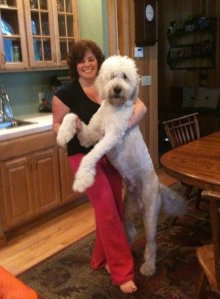
He was a very stubborn puppy (like mother, like son), so I was very strict in his discipline to ensure that he knows I’m the boss, the leader of the pack, and his mama. Today, despite his size, he’s awesomely well behaved, incredibly friendly, and a lover of life. *However, given him a bath is a pain in the butt.

Meanwhile, because of his size, it’s also really easy to tackle him, wrestle him, and basically wrap my whole body around him when I need him to sit still while my friend is cleaning his ears (he hates that!).

I also recently adopted a 9 year-old pup named Einstein. He’s learning from Blue how great life can be. He was given to a shelter because his owner was dying, and I don’t think his owner took him outside very often. He didn’t even know his name or how to sit when I got him.
Today, due to lots of cuddling, kisses, and walks in the woods, he’s become a very happy canine…and a good friend of Blue’s.

S: I started reading your book (and will continue just as soon as I finish the Hunger Games trilogy!!). So far I loved how you explain things. What was the moment when you thought, I’m going to write this book?

G: Hmm…well, when I started powerlifting training during 2009, I had to learn so much about basic human physiology because not only did the endocrinologists in my area know nothing about competitive sports, exercise and diabetes, but the head endocrinologist there also rolled his eyes at me when I said I wanted to train and compete in powerlifting.

So I was on my own.

I read medical textbooks and talked a lot with my trainer, Andrew, about basic exercise physiology. After really coming to understand it well, and taking a lot of notes around my own blood sugars, training workouts, and competitions, I realized that this was my book. This information that you can’t find easily anywhere else.

It’s frustrating to me, in one sense, that doctors don’t take the time to teach us some of this stuff, but I know they don’t have time. We are all capable of learning it though, and it applies to every part of life with diabetes.

S: Your newest venture was becoming the mental health coach for Team WILD. How is that going?

G: Oh, it’s only just begun! TeamWILD is founded by the awesome Mari Ruddy (a two-time cancer survivor and tri-athlete living with Type 1 diabetes). Working with and for Mari is great because she sees what her staff is capable of and gives them the reigns to be as awesome as they can be.

TeamWILD is holding it’s camp in Boulder this coming June, and I will be one of the main 4 staff members running the camp. You’ll also find three videos from me in your training packages if you sign-up for any of the various programs TeamWILD offers!

Wanting to exercise is the first step, but the next step is making sure that you’ve learned everything you need to in order to exercise effectively, safely, and productively with diabetes. Going for a jog when your blood sugar is 240 mg/dL, even if you don’t have ketones, isn’t going to give you all of the benefits you’re hoping for. You’ve gotta learn how your body works and how to manage diabetes on top of that.

TeamWILD is an awesome source for learning that information, and reaching all of your athletic goals in endurance sports.

If you haven’t already, I would highly recommend interacting with Ginger online – I’ve included links where to find her at Living In Progress, her book Your Diabetes Science Experiment which can be purchased as a paperback or an e book, her services at Team Wild and you can also find her on twitter @gingervieira 🙂

Diabetes Alert Day.

I live with a type of diabetes that cannot be prevented or reversed. My diet or weight as a five year old had nothing at all to do with why I was diagnosed. I have taken insulin every day for the past 30 years to stay alive. Eating right and exercising of course helps me stay healthy overall and does improve my blood sugar readings but it will not get rid of my diabetes. There are about 900,000+ other people in the US alone who are in the same boat as me. But that is only 5% of the diabetic population. There are approximately 18 million more people in the US who have type 2 diabetes. Type 2 diabetes is when the body does not produce enough insulin or does not utilize it properly. It is sometimes linked to diet and(or) lifestyle. There are different treatment options for type 2 diabetes depending on each case, including diet and exercise, oral medication and insulin.

The CDC estimates that there are an additional 7 million people in the US that have diabetes and do not know it. That is an astounding number. Any type of diabetes is no joke. But you can live a fulfilling life with diabetes as long as you get the medical care you need. Today is American Diabetes Association Alert Day. If you aren’t already living with diabetes, please take a few minutes to take the ADA’s risk test for type 2. And share it with your friends and family members. Early diagnosis is crucial. I was extremely fortunate to have parents who recognized the symptoms before I was even sick. And I am certain that has helped me maintain a life of diabetes with minimal complications up to this point.  Knowledge is power when it comes to anyone’s health.  And if you or someone you love happens to be diagnosed with diabetes, know that there is an extraordinary community waiting to help you.

JDRF Summit.

This past weekend I had the great opportunity to attend the JDRF Type 1 Research Summit in Maryland hosted by the JDRF Capitol chapter.  I have attended diabetes events before but never one that was focused on research for advancements in management and a cure for type 1 diabetes.  I’m really glad I went.

Joe and I made a weekend trip out of it and did a little sight-seeing in DC.  That was nice.

Of course the first thing I spotted when getting out of the metro station was Crumbs bakery!  We didn’t indulge but just seeing the sign put a smile of my face 🙂 

We also got a glimpse of the Occupy DC movement that still resides near the capitol.

The summit itself was a day full of education to say the least.  We heard from presenters like Dr. Juan Dominguez-Bendala from the Diabetes Research Institute, Adam Brown from Close Concerns and diaTribe, Dr. Mark Atkinson and Dr. Desmond Schatz from the Diabetes Center of Excellence at the University of Florida, Dr. Stuart Weinzimer from Yale School of Medicine Pediatric Endocrinology, Cynthia Rice from JDRF Government Relations, Marie Schiller from Health Advances and T1D First and Gary Scheiner from Integrated Diabetes Services.  The moderator was Riva Greenberg, columnist at the Huffington Post.  I thought each and every one of the presentations were very informative and well demonstrated.

A lot of the guests spoke about the current and future research that is being done for type 1 diabetes.  Some in terms of the steps to get to the artificial pancreas and some in terms of getting to a cure.  I won’t pretend that I understood all the scientific or medical terminology but it did reiterate how extremely difficult it is to find a cure that will work.  I’ve been living with diabetes for 30 years already and for so many of those first years, my family and I heard that there would be a cure in the next 10 years or so.  For this reason and not being a pessimist, I don’t think I will see a cure in my lifetime.  However, hearing all that is being done in terms of research, even to improve the quality of diabetes management, does give me a little more hope to hang on to.  Especially after hearing Gary’s presentation about how much things have changed in the last 25 years.  Who remembers the autolet lancing device (shown below)?? That thing was horrible!

One highlight of attending the summit was not only did I get to spend time with some of my D friends, I got to meet some more in person!  I got to meet Tony, Colleen, Bennet and Kim and that was a huge plus to the weekend.

Another highlight was getting to see the t-slim insulin pump by Tandem in person at the exhibit hall.  I got to hold it and test it out (without being hooked up of course).  My initial opinion is that it is very sleek and slim – hence the name!  It holds 300 units of insulin which is a plus to a lot of people.  The touch screen makes moving around the menu and entering functions very simple and easy.  Tandem says the pump is waterproof for up to 3 feet for 30 minutes.  To me that’s not really water”proof” but better than nothing if getting caught in a downpour or accidentally coming in contact with a lot of water.  The only thing that makes me hesitant about the device is that it has to be charged like other electronic devices.  Charging something that is attached to you poses some doubts for me personally.

Overall it was a great experience and I applaud the JDRF Capital chapter for organizing a great event at no charge to the attendees.  I would highly recommend going to any future conference to anyone that has a loved one with type 1 diabetes in their life.

A Weekend You Don’t Want to Miss.

Last spring, I attended the Weekend for Women conference hosted by Diabetes Sisters. I didn’t know of many women who had gone before and didn’t know of a lot of women who were planning on attending. But it sounded like a great event and decided to go. Plus I had never been to North Carolina before and thought checking out Raleigh would be a pleasant experience. Boy was I right! Both the setting and the event itself were fabulous. I got to hang out with Allison and meet Sysy and Sarah and Brandy, of course. I also got to experience memorable moments with my diabetes sisters.

This year’s conference is being held in the same location in May. I am so excited that I registered today for the conference and booked the hotel. Now all I need is to find me some cheap airfare!  This year they are even adding a special program for partners of those living with diabetes, hosted by some awesome guys. I highly encourage any female with any type of diabetes or that even has a loved one with diabetes to attend this weekend for women.  You won’t be sorry. You will positively feel like part of a sisterhood.

Please check out this link for all the info: 2012 Raleigh Conference.  And I hope to see you there 🙂